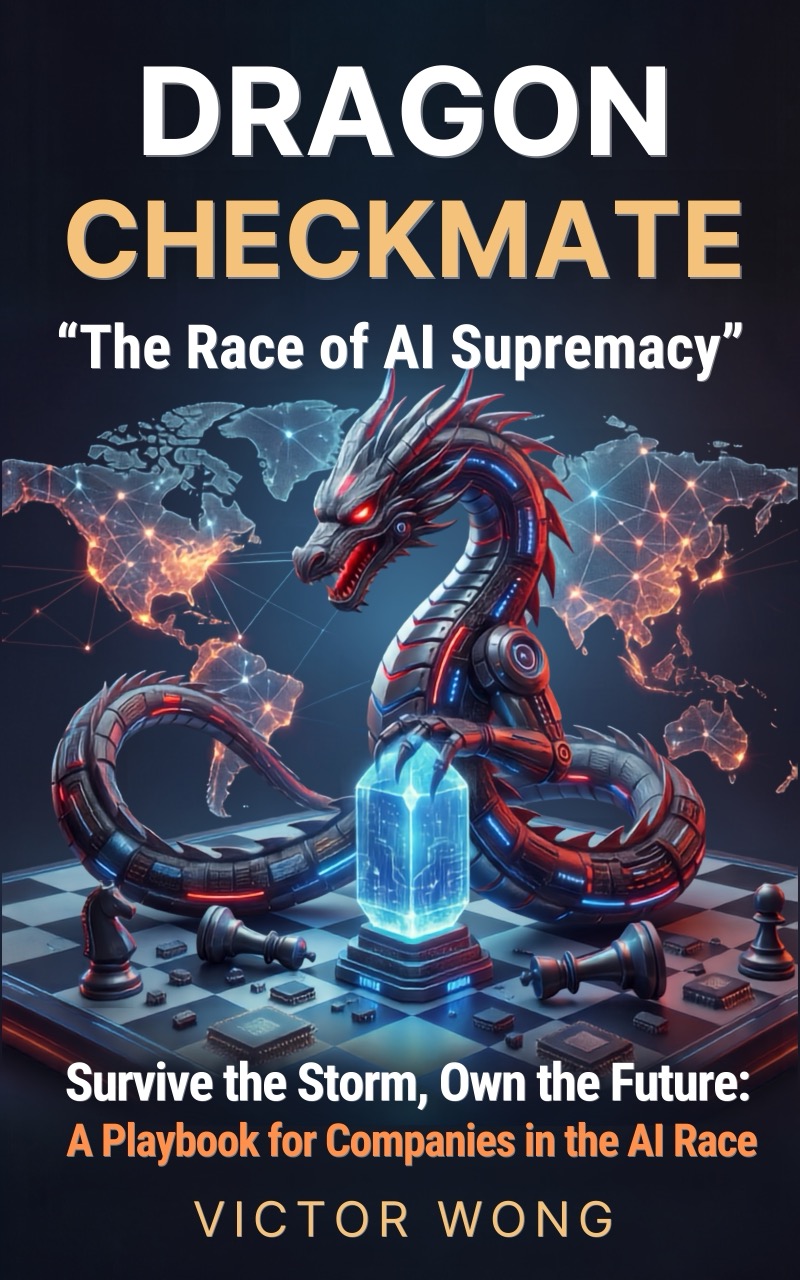
Survive the storm, own the future
A survival manual for companies that refuse to become a case study: the audit that tells you if you're the next Kodak or the next Fujifilm, six defensive moves, and three 2030 endgames.
What each chapter argues, in order, with the figures it uses. From chapter 1 to the last page.
Part I — The Storm
The chapter argues the race for AI supremacy began not with ChatGPT but on March 9, 2016, in Seoul, when DeepMind's AlphaGo — built by a British lab owned by an American company — beat 18-time world champion Lee Sedol four games to one, making the opening move American. ChatGPT's release on November 30, 2022 changed the race from a laboratory contest into an economic one, reaching one million users in five days and 100 million monthly users in two months. The central event is January 27, 2025, when DeepSeek, a one-year-old Chinese startup, triggered a $589 billion single-day loss at Nvidia and roughly $1 trillion of American market value to evaporate. The author reduces the race to three forces: compute, growing about 5× per year since 2020 and doubling every 5.2 months; capital, seen in Nvidia's rise from $1 trillion in mid-2023 to the first $4 trillion valuation on July 9, 2025; and cadence, moving from annual to quarterly and, in 2026, monthly frontier releases. GPT-4 used roughly 100× the compute of GPT-3. The takeaway is the book's thesis: the AI race is a survival contest between two economic systems, and companies that treat it as business-as-usual will be checkmated.
Table 1.3 — The frontier release calendar (selected models)
| Date | Model | Organization | Significance |
|---|---|---|---|
| Mar 14, 2023 | GPT-4 | OpenAI | Multimodal frontier; the benchmark to beat |
| Dec 2023 | Gemini 1.0 | Google DeepMind | Google's answer to GPT-4 |
| Mar 2024 | Claude 3 | Anthropic | Rival frontier model, safety-branded |
| Apr 18, 2024 | Llama 3 | Meta | Open-weight frontier |
| May 13, 2024 | GPT-4o | OpenAI | Free multimodal voice assistant |
| Dec 26, 2024 | DeepSeek-V3 | DeepSeek | The $5.6M training claim |
| Jan 20, 2025 | DeepSeek-R1 | DeepSeek | Low-cost reasoning → market shock |
| Jul 2025 | Grok 4 | xAI | New entrant at the frontier |
| Aug 7, 2025 | GPT-5 | OpenAI | Merged reasoning; next platform step |
| Nov 18, 2025 | Gemini 3 Pro | Google DeepMind | GPQA Diamond 91.9% (no tools) |
| Nov 24, 2025 | Claude Opus 4.5 | Anthropic | GPQA Diamond 87.0% (no tools) |
| May 28, 2026 | Claude Opus 4.8 | Anthropic | Honesty/reliability push; 42 days after Opus 4.7 |
| Jun 9, 2026 | Claude Fable 5 | Anthropic | Mythos-class frontier; new tier above Opus |
| Jul 24, 2026 | Claude Opus 5 | Anthropic | Near-Fable frontier at half the price |
Source: OpenAI (2023, 2024, 2025); allmo.ai release tracker; getmaxim.ai frontier comparison (2025); felloai.com (2025); Anthropic (May 28, Jun 9, Jul 1, Jul 24, 2026). See References.
Table 1.1 — The AI race timeline, 2016–2026
| Year | Event | Why it mattered |
|---|---|---|
| 2016 | AlphaGo beats Lee Sedol 4–1 (Seoul) | First machine mastery of Go; AI era announces itself |
| 2020 | GPT-3 released (175B parameters) | Scale becomes the playbook; ~$4.6M training estimate |
| 2022 | ChatGPT launches (Nov 30) | 1M users in 5 days; fastest adoption in consumer history |
| 2023 | GPT-4 (Mar); Gemini (Dec) | Frontier race becomes an open two-superpower contest |
| 2024 | Llama 3 (Apr); GPT-4o (May); export controls tightened | Open weights + multimodality + chip restrictions |
| 2025 | DeepSeek R1 (Jan); Nvidia hits $4T (Jul); GPT-5 (Aug); Gemini 3 Pro (Nov) | Efficiency shock; capital supercycle peaks |
| 2026 | Claude Opus 4.8 (May); Claude Fable 5 (Jun); Claude Opus 5 (Jul) | The frontier accelerates to a monthly cadence |
Source: compiled from the sources listed in References (see items 1–28).
The chapter argues that China's AI rise was funded, organized, and directed by the state, and that by 2026 it had become the only competitor capable of threatening American AI dominance. The clearest instrument is the Big Fund: its third phase, announced in May 2024, committed 344 billion yuan ($47.5 billion) to advanced AI chips and the domestic supply chain, following a 2025 state venture fund of roughly $138 billion. State money built a bench of national champions — Alibaba's Qwen, Tencent's Hunyuan, Baidu's Ernie, ByteDance's Doubao, Huawei's Ascend, DeepSeek, iFlytek, and SenseTime. China leads the world in AI publications and citations (20.6% of global citations in 2024 versus the U.S. at 12.6%) and holds roughly 70% of generative-AI patents for 2014–2023, though the U.S. still leads in highly influential research. The dragon's bottleneck is chips: Huawei's Ascend 910B improved only 1.2× over its first generation, and HBM shortages cap its completed 2025 output at 200,000–300,000 chips. The chapter introduces Go Global 3.0, the export of the AI value chain through firms like Unitree, MiniMax, and Zhipu.
Table 2.2 — China's AI national champions
| Company | AI flagship | Role |
|---|---|---|
| Alibaba | Qwen (open-weight LLMs) | Cloud + model leader |
| Tencent | Hunyuan | WeChat-scale consumer AI |
| Baidu | Ernie (ERNIE) | Search + LLM first-mover |
| ByteDance | Doubao | Consumer AI at TikTok scale |
| Huawei | Ascend 910B/C + MindSpore | Domestic chip champion |
| DeepSeek | V3 / R1 | Efficiency breakthrough (2025) |
| iFlytek | Spark (Xinghuo) | Speech AI, trained on Ascend |
| SenseTime | SenseNova | Computer vision pioneer |
Source: CSET, "Pushing the Limits: Huawei's AI Chip Tests U.S. Export Controls" (2024); RAND, "Leashing Chinese AI Needs Smart Chip Controls" (2025); Stanford AI Index Report 2025.
Table 2.1 — China's state AI war chest
| Fund | Year | Size | Focus |
|---|---|---|---|
| Big Fund I | 2014 | 138.7B yuan (~$19B) | SMIC, Hua Hong, memory, chip ecosystem |
| Big Fund II | 2019 | Undisclosed | Chip equipment and advanced process |
| Big Fund III | 2024 | 344B yuan ($47.5B) | Advanced AI chips, full supply chain |
| National Venture Capital Guidance Fund (target) | 2025 | 1T yuan (~$138B) | AI, quantum, semiconductors, frontier tech |
| National Venture Capital Guidance Fund (initial injection) | 2025 | 600B yuan | First tranche of the 1T target |
Source: Reuters (May 27, 2024); Caixin Global (May 28, 2024); Stanford AI Index Report 2026.
The chapter measures the American arsenal and asks whether the U.S. lead is real and durable. Its anchor is capital: Amazon, Alphabet, Microsoft, and Meta spent roughly $410 billion on AI and data centers in 2025 and guided to approximately $725 billion for 2026, a 77% jump that Goldman Sachs projects will total $5.3 trillion from fiscal 2025 through fiscal 2030. The profit center is Nvidia, whose revenue rose to $215.9 billion in FY2026 (+65%) at non-GAAP gross margins above 75%, with data-center revenue of $75.2 billion in a single quarter (Q1 FY2027). The CHIPS and Science Act of 2022 added $52.7 billion. On talent, the author notes that Chinese-origin researchers make up 38% of top U.S. AI researchers versus 37% American-born — an advantage that is imported, not native, and that Stanford's 2026 AI Index says is declining. American institutions produced 81 of 102 notable models in 2025. The takeaway: no other country matches all four layers at once, but every advantage carries a warning label — capital, chips, talent, and the frontier all depend on conditions that can erode.
Table 3.1 — The hyperscaler capital engine (capex, approximate)
| Company | 2025 actual | 2026 guidance |
|---|---|---|
| Amazon | ~$100B | ~$200B |
| Alphabet/Google | ~$91B | $175–185B |
| Microsoft | ~$90B | ~$190B |
| Meta | ~$65B | ~$125B |
| Combined | ~$410B | ~$725B |
Source: CNBC (Feb 8, 2025); company earnings guidance compiled via ValueAdd VC (Aug 2026); Data Center Richness (2026).
Table 3.2 — NVIDIA's financial engine
| Metric | FY2024 | FY2025 | FY2026 | Q1 FY2027 |
|---|---|---|---|---|
| Total revenue | $60.9B (+126%) | $130.5B (+114%) | $215.9B (+65%) | $81.6B (record, +85%) |
| Data center revenue | $47.5B (+217%) | $115.2B (+142%) | $197.3B (+71%) | $75.2B (+92% YoY) |
| Data center / Total revenue | 78.0% | 88.3% | 91.4% | 92.2% |
| Gross margin (non-GAAP) | 73.8% | 75.5% | 75.2% | ~75% |
Source: NVIDIA press releases, Q4 FY2025 and Q4 FY2026; NVIDIA Investor Relations (Q1 FY2027 results).
The chapter builds an honest head-to-head scoreboard and argues that both superpowers' narratives are partly true. The United States produced 81 of 102 notable AI models in 2025, invested $285.9 billion in private AI against China's $12.4 billion, and created 1,953 new AI companies versus China's 161. China produced roughly 70% of the world's generative-AI patents, leads in AI publications and citations, and announced a $138 billion state fund. Across six columns — compute, models, capital, talent, energy, and chips — the author finds America winning the fast-compounding columns and China closing on the slow ones. Compute grows about 5× per year; on chips, roughly one million Nvidia H20s sold to China in 2024 against 450,000 Huawei Ascend 910Bs. Data centers consumed about 415 terawatt-hours in 2024, and the U.S. is 45% of global data-center electricity. The chapter also covers the second tier of countries and the so-called From Apple to Ford pattern of Western firms sourcing Chinese capability. The verdict: America leads, China is closing, and the lead is not permanent.
Table 4.1 — The AI race scoreboard (US vs China)
| Metric | United States | China |
|---|---|---|
| Notable AI models, 2024 | 40 | 15 |
| Notable AI models, 2025 | 81 of 102 global | ~8 |
| Private AI investment, 2025 | $285.9B | $12.4B |
| Cumulative private AI investment | $757.3B | $131.8B |
| New AI companies, 2025 | 1,953 | 161 |
| GenAI patents, 2014–2023 | ~25% (est.) | ~70% of world |
| AI publications & citations | Leads in influence | Leads in volume |
| Top AI researchers employed | Majority of top-tier | Trains most origin-researchers |
| Data center electricity | 45% of global DC use | ~2nd largest |
| Frontier AI chips | NVIDIA H100/H200/B200 | Huawei Ascend 910B/C |
| Training compute growth | 5×/yr since 2020 | ~4×/yr (est.) |
Source: Stanford AI Index 2025 & 2026; WIPO Patent Landscape Report; MacroPolo; IEA Energy and AI (2025); Epoch AI; RAND; CFR. Individual figures cited below.
Table 4.2 — The rest of the world (2025 data)
| Country/Region | Private AI investment (2025) | New AI companies | Notable strength |
|---|---|---|---|
| United States | $285.9B | 1,953 | Everything: chips, models, capital, talent |
| China | $12.4B | 161 | State funds, patents, talent production |
| United Kingdom | $5.9B | 172 | DeepMind, AI research, finance |
| France | $4.4B | — | Mistral AI ($14B valuation), open models |
| Europe (combined) | ~$12.8B (AI startup funding) | — | Sovereignty push, AI Act, Mistral/SAP |
| Canada | $4.3B | — | AI research, government investment |
| India | $4.1B | — | Scale economy, engineering talent |
Source: Stanford AI Index Report 2026 (US, China, UK, France, Canada, India); Dealroom (Europe AI startup funding, 2025); Reuters (Mistral, Sept 2025).
Part II — The Battlefield
The chapter argues that the AI race rests on a silicon pyramid of three near-monopolies — Nvidia (~80–92% of AI accelerators), TSMC (~70% of the foundry market), and ASML (a practical monopoly on EUV lithography) — plus a quiet middle layer held by Arm, a British company owned by Japan's SoftBank. China's workaround is SMIC's 7-nanometer process built on DUV multi-patterning, the technology inside the 2023 Mate 60 Pro. The second front is a memory war: Samsung, SK Hynix, and Micron control about 95% of DRAM and shifted roughly 93% of capacity toward HBM, driving DRAM contract prices up 90–95% in the first quarter of 2026 and spot prices up nearly 700% year over year. China's CXMT became the world's fourth-largest DRAM maker but lags three to four years on HBM. The third front is humanoid robots: of roughly 15,000 shipped globally in 2025, Unitree and AGIBOT each shipped over 5,000 while Tesla and Figure AI shipped a few hundred. The author concludes that America may be losing the hardware war but winning the intelligence war.
Table 5.2 — The memory war scoreboard (2025–26)
| Metric | Value | Source |
|---|---|---|
| DRAM market controlled by Samsung/SK Hynix/Micron | ~95% | IDC |
| Production shifted to HBM (combined) | ~93% | NAND Research/TrendForce |
| DRAM contract price rise, Q1 2026 (QoQ) | 90–95% | TrendForce |
| DRAM spot price rise, 12 months to Jul 2026 | ~700% | Bloomberg |
| CXMT 2025 revenue / 1Q26 revenue | $8.6B (+156%) / $7.3B | SemiAnalysis |
| CXMT global DRAM bit share | 9% (2025) → 12% (2027) | SemiAnalysis |
| CXMT HBM yield vs industry standard | ~25% vs 85–90% | SemiAnalysis |
| SK Hynix CEO on shortage duration | "Beyond 2030" | Bloomberg, Jul 2026 |
Source: SemiAnalysis Memory Model (June 2026); IDC; TrendForce; Bloomberg (July 2026); NAND Research.
Table 5.3 — The robot war scoreboard (2025–26)
| Company | Country | 2025 shipments | Status / price |
|---|---|---|---|
| Unitree | China | 5,000+ | G1 at ~$16,000; on Amazon US |
| AGIBOT | China | 5,000+ | Automotive pilots |
| Tesla (Optimus) | US | Few hundred | Gen 3; killed Model S/X lines to build robots |
| Figure AI | US | Few hundred | Figure 03 billing BMW ~$25/robot-hour |
| Boston Dynamics (Atlas) | US | Pilot | Enterprise tests at Hyundai |
| Global total | — | ~15,000 | ~85% made in China |
Source: Omdia via AP/NBC (July 2026); Counterpoint Research; LumiChats 2026 market guide.
The chapter argues the model war is fought on two fronts — raw capability and efficiency — and that the January 2025 DeepSeek shock made the second undeniable. On capability, GPQA Diamond scores in late 2025 put Gemini 3 Pro at 91.9%, Claude Opus 4.5 at 87.0%, and GPT-5 at 85.7%, with Anthropic compressing releases to a monthly cadence by 2026. On cost, the escalation curve runs from GPT-3's estimated $4.6 million in 2020 to more than $100 million for GPT-4 in 2023, while DeepSeek reported a $5.576 million final training run for a comparably capable model — the number behind Nvidia's $589 billion single-day loss. The author notes DeepSeek's total chip spend likely exceeded $500 million, so the lesson is efficiency, not cheapness. DeepSeek-R1, released January 20, 2025, matched frontier capability on constrained H800 hardware and open-sourced it. The cost shock then went viral as American companies — Airbnb on Alibaba's Qwen, Coinbase running roughly 1,200 agents on Chinese models, Uber, and Lindy — turned to cheaper Chinese weights. Apple's two-year struggle to launch Apple Intelligence in China, ending in a partnership with Alibaba and Baidu, closes the chapter.
Table 6.2 — The training-cost escalation
| Model | Year | Reported training cost | Source |
|---|---|---|---|
| GPT-3 | 2020 | ~$4.6M (estimate) | Lambda via Wikipedia |
| GPT-4 | 2023 | >$100M | Sam Altman at MIT (via Wired) |
| DeepSeek-V3 | 2024 | $5.576M (reported run cost) | DeepSeek-V3 report via Stanford FSI |
| GPT-5 generation | 2025 | Not disclosed; industry estimates $500M+ | Epoch AI; reporting |
Source: Wired (April 2023); Stanford FSI (2025); Epoch AI trends (2025).
Table 6.3 — Apple's road to Chinese AI (the timeline)
| Date | Development | Source |
|---|---|---|
| Jun 2024 | Apple Intelligence launches in the US; unavailable in China | SCMP |
| Dec 2024 | Apple in talks with Tencent, ByteDance, Baidu (Hunyuan, Doubao, Ernie) | Reuters, Dec 19, 2024 |
| Feb 2025 | Apple partners with Alibaba; Baidu passed over; DeepSeek considered and rejected | Reuters, Feb 11, 2025 |
| Jul 2026 | Regulators approve Apple Intelligence; Alibaba + Baidu named technical partners | SCMP, Jul 15, 2026 |
Source: Reuters (Dec 19, 2024; Feb 11, 2025); SCMP (July 15, 2026); The Information.
The chapter argues that the AI race is ultimately a competition for a few thousand minds, the only input that cannot be manufactured or imported in bulk. It opens with Meta's reported offer of a compensation package exceeding $100 million in equity to Scale AI's Alexandr Wang. The pipeline splits into two halves: production, where CSET finds Chinese universities will produce more than 77,000 STEM PhDs a year against roughly 40,000 in the United States and MacroPolo shows the share of top AI researchers educated in China rising from 27% in 2017 to 38% in 2024; and employment, where those researchers overwhelmingly work in U.S. labs, with Chinese-origin researchers at 38% of top U.S. AI talent versus 37% American-born. The chapter prices a frontier mind: median compensation of roughly $700,000–$900,000 at the leading labs, top-of-band packages of $1.5–3 million, and Meta's nine-figure acqui-hires. It cites Google's $2.7 billion deal to bring back Noam Shazeer and Microsoft's $650 million Inflection deal for Mustafa Suleyman, and warns that OpenAI's promised 20% compute for its Superalignment team was never delivered.
Table 7.2 — The price of a frontier mind (2025–26 reported compensation)
Chart drawn from the table below, using the book’s own figures.
Table 7.2 — The price of a frontier mind (2025–26 reported compensation)
| Company | Median total comp | Top of band |
|---|---|---|
| OpenAI | ~$900K | $2.5M+ (L7) |
| Anthropic | ~$850K | $2M+ (Staff) |
| Google DeepMind | ~$700K | $1.5M+ (L8) |
| xAI | ~$650K | $1.5M+ (Staff) |
| Meta Superintelligence | ~$1.1M | Nine-figure packages (Wang acqui-hire) |
| NVIDIA | ~$550K | $1.8M+ (Staff) |
Source: CTAIO AI company compensation guide (2026); Business Insider (2025); Euronews (2026).
Table 7.1 — The talent pipeline (top-tier AI researchers)
| Metric | United States | China |
|---|---|---|
| STEM PhDs produced per year | ~40,000 | 77,000+ |
| Share of top AI researchers educated (2017 → 2024) | Declining share | 27% → 38% |
| Share of top AI researchers employed | Majority of global top-tier | Minority; mostly domestic |
| Chinese-origin researchers among top U.S. AI talent | 38% (vs 37% American-born) | — |
Source: CSET (2024); MacroPolo Global AI Talent Tracker 3.0; The New York Times (March 22, 2024).
The chapter argues that power, not chips, is becoming the binding constraint on the AI race. Data centers consumed about 415 terawatt-hours in 2024 — roughly 1.5% of global electricity — and the IEA projects that to double to about 945 TWh by 2030. The United States is the epicenter, accounting for 45% of global data-center electricity and using about 4.9% of its own electricity against China's 1.1%, with one ChatGPT query consuming roughly 2.9 watt-hours, about ten times a Google search. The industry's answer is nuclear: Microsoft signed a 20-year, 835-megawatt power purchase agreement to restart Three Mile Island, announced September 20, 2024, and Google agreed to buy 500 megawatts from Kairos Power's small modular reactors on October 14, 2024. The author notes nuclear plants take a decade to build, and that the grid's interconnection queues are the real choke point, with Eric Schmidt testifying that data centers will need 29 gigawatts more power by 2027. America leads today, but China's state-directed grid is the structural challenger for the 2030s.
Table 8.1 — The power trajectory (global data centers)
| Year | Electricity consumption | Share of global electricity |
|---|---|---|
| 2024 | ~415 TWh | ~1.5% |
| 2025 | ~485 TWh | ~1.5–1.6% |
| 2030 (IEA base case) | ~945 TWh | ~3% |
Source: IEA, Energy and AI (2025); Our World in Data (IEA data).
Table 8.2 — The nuclear deals
| Deal | Announced | Capacity | Significance |
|---|---|---|---|
| Microsoft × Constellation (Three Mile Island) | Sep 20, 2024 | 835 MW (20-yr PPA) | Restart of TMI Unit 1; largest-ever Constellation PPA |
| Google × Kairos Power | Oct 14, 2024 | 500 MW (6–7 SMRs) | World's first corporate SMR purchase |
| OpenAI (advocacy) | 2024–25 | Gigawatt-scale ambition | Industry's loudest voice for nuclear build-out |
Source: Constellation Energy press release (Sept 20, 2024); Reuters (Oct 14, 2024); OpenAI public statements.
Part III — The Playbook
The chapter turns the storm into an audit and argues that the question is no longer whether AI hits a company's industry but whether the company is positioned to survive. It opens with Kodak, worth $31 billion in 1997, which invented the digital camera in 1975, buried it, and fell to roughly $140 million and bankruptcy by 2012. McKinsey's 2025 survey found 88% of organizations using AI, 79% using generative AI, and 62% experimenting with agents, while GitHub and Microsoft Research measured developers completing tasks 55% faster with Copilot. The audit asks five questions, including whether AI can do your core product at one-tenth the cost, and sorts companies into three categories: the Disrupted, the Augmented, and the Platform. A cautionary cabinet supplies real cases — Chegg, whose stock fell nearly 48% in a day in May 2023; Ritz Camera; New York taxi medallion owners; and Thomas Cook, which collapsed in 2019 after 178 years — set against survivors like Fujifilm and Sheló NABEL. The takeaway: companies do not die from the technology but from the delay in acting on it.
Table 9.3 — The cautionary cabinet: what denial costs
| Company | The moment | The number | The lesson |
|---|---|---|---|
| Kodak | Invented digital camera (1975), buried it | $31B → $140M → bankruptcy (2012) | Protecting yesterday kills tomorrow |
| Blockbuster | Rejected Netflix at $50M (2000) | 9,000 stores, $6B revenue → bankruptcy (2010) | "Partially" exposed is fully exposed |
| Chegg | CEO admitted ChatGPT hurt growth (May 2023) | −48% in one day; −99% from $14.7B peak | The storm announces itself in one earnings call |
| Ritz Camera | Kept selling film as digital arrived | $100M+ debts → Ch. 11 (2009) → closed (2012) | Yesterday's logic has a price tag |
| NYC taxi medallion owners | Waited for the medallion's "true value" | $1.3M → ~$136K; 950+ bankruptcies | The costliest decision is the one not made |
| Fujifilm | Same film disruption as Kodak | Survived via healthcare/cosmetics pivot | Denial is a choice; so is reinvention |
| Thomas Cook (UK) | Kept borrowing to defend the old model | 21,000 jobs lost; 600,000 stranded (2019) | 178 years of survival do not excuse one year of delay |
| Sheló NABEL | Applied AI to inventory/sales early | +17% sales; 5× faster reporting | Category 2 winners act early |
Source: CNBC (Chegg, May 2023); Courthouse News/Wikipedia (Ritz Camera, 2009–2012); Columbia HR Law Review/NYT (medallions); Wikipedia/PBS (Thomas Cook, 2019); Microsoft customer story (Sheló NABEL); Forbes; Quartr; company histories.
Table 9.1 — The storm, measured
| Metric | Value | Source |
|---|---|---|
| Organizations using AI (2025) | 88% | McKinsey State of AI 2025 |
| Organizations using gen AI (2025) | 79% (up from 33%) | McKinsey State of AI 2025 |
| Organizations experimenting with AI agents | 62% | McKinsey State of AI 2025 |
| Gen AI economic potential | $2.6–4.4T/year | McKinsey (2023) |
| Copilot developer speedup (controlled study) | 55% faster | GitHub/Microsoft Research |
Source: McKinsey & Company; GitHub research (arXiv 2302.06590).
The defensive playbook is written for Category 1 companies whose core product is being substituted, and its thesis is Buffett's two rules applied to AI: do not lose the company, and remember rule one. The author names three predictable mistakes — denial, protecting the old business, and waiting for certainty — made in order by Kodak, Blockbuster, and New York taxi drivers. The five-step sequence runs from cutting everything that is not the future to preserve 24–36 months of runway, to naming and separately funding the pivot, to applying AI to cut the cost of what remains, to measuring the pivot against hard milestones. The case files include taxi medallions falling from $1.3 million in 2013 to about $136,000 by 2019, Family Video closing in 2021 despite outlasting every rival, independent bookstores recovering from 1,916 to 3,218 stores, and travel agencies moving upmarket. A sixth step, partner with the local champion, is drawn from Volkswagen's roughly $700 million investment for 4.99% of Xpeng in July 2023 and the jointly developed CEA architecture delivered in 18 months.
Table 10.3 — The Volkswagen–Xpeng case at a glance
| Element | Detail | Source |
|---|---|---|
| Investment | ~$700M for 4.99% stake ($15/ADS) | Reuters; Xpeng IR; VW Group, Jul 2023 |
| Joint products | Two VW-branded EVs on Xpeng platform | Reuters; CNN, Jul 2023 |
| Architecture deal | CEA master agreement (CARIAD China + Xpeng) | VW Group, Jul 2024 |
| Delivery speed | 18 months — VW's fastest new E/E architecture | VW Group China, 2025 |
| The context | BYD overtook VW as China's #1 brand in 2024; VW China sales −25.9% H1 2026 | Reuters; European Business Magazine |
| The twist | VW briefly reclaimed China's top spot as EV subsidies faded (early 2026) | Reuters, Mar 2026 |
Source: Reuters (July 26, 2023; March 13, 2026); Volkswagen Group press releases; Xpeng Investor Relations; European Business Magazine (2026).
Table 10.2 — Five SME cases, five rules proven
| Company / industry | The defensive move | The number | The rule it proves |
|---|---|---|---|
| NYC taxi medallion owners | Waited for the medallion's "true value" | $1.3M → ~$136K; 950+ bankruptcies | The asset of yesterday is not the asset of tomorrow |
| Family Video | Cut costs, owned real estate, kept renting | Last chain standing; closed 2021 anyway | Efficiency is not survival; the pivot must change what you sell |
| Independent bookstores | Pivoted from products to community/experience | 1,916 → 3,218 stores (+70%, 2020–25) | The incumbent's real asset is trust, not product |
| Travel agencies (survivors) | Moved upmarket to high-complexity bookings | 34,000 → 13,000 locations; survivors thrive | Name the pivot: move where the technology can't reach yet |
| Small manufacturers | Adopted AI despite the J-curve dip | ~1.33-pt initial dip; outperform peers by year 4 | AI adoption looks like a mistake — right before it pays |
Source: Columbia Human Rights Law Review/NYT (medallions); RetailDive (Family Video, 2021); American Booksellers Association/Civic Economics (bookstores); CNN/martinalderson.com travel-industry data (agencies); MIT Sloan/Census Bureau CES-WP-25-27 and Cooper (2025) for SMEs (manufacturers).
The offensive playbook is written for Category 2 companies and for the survivors of the defensive sequence, and its thesis is Alan Kay's: the future will be invented by someone, so it may as well be you. The chapter maps the AI value stack and argues that infrastructure and models are capital wars for a handful of winners, while the application layer — where McKinsey's $2.6–4.4 trillion annual value pool lives — is wide open. It sets out five compounding moves: pick one wedge with a measured P&L, industrialize it, build the data moat, hire the scarce and automate the rest, and treat AI as a quarterly discipline. For companies outside the United States, a global playbook offers three moves — be the local sovereign, own your language and data, and move before the platform does — citing Mistral's SAP partnership and the UAE's G42. The chapter closes on small teams that won: Midjourney reaching roughly $200 million in revenue with about 40 people and no venture capital, ElevenLabs at over $330 million ARR and an $11 billion valuation, and HeyGen growing from $1 million to $200 million ARR.
Table 11.1 — The AI value stack and where the money is
| Layer | Who wins | Real-world examples | Current dynamic | Time horizon |
|---|---|---|---|---|
| Infrastructure (chips, compute, energy) | NVIDIA, hyperscalers, power | NVIDIA (GPUs); TSMC (fabrication); Microsoft/Amazon/Google (cloud); Constellation (nuclear) | $725B/yr capex; power is the new constraint | Now–2028 |
| Models (frontier + open) | OpenAI, Google, Anthropic, Meta; open-weight ecosystem | OpenAI (GPT-5); Google (Gemini 3 Pro); Anthropic (Fable 5/Opus 4.8); Meta (Llama); DeepSeek; Mistral; Cohere | Frontier reshuffles quarterly; efficiency is the weapon | Now–2027 |
| Applications (AI-native products) | Companies with proprietary data + distribution | Midjourney (text-to-image); ElevenLabs (voice); HeyGen (video avatars); OpenAI (ChatGPT) | The widest-open pool; 79% adoption is the beachhead | 2026–2030 |
| Services (AI-augmented incumbents) | Every Category-2 company that moves | Sheló NABEL (distribution); VW–Xpeng (autos); independent bookstores and travel agencies | 55% productivity effect compounds | Ongoing |
Source: author's framework, built on McKinsey (2023, 2025), Part II chapters of this book; examples from Chapters 6, 9, 10, and this chapter's cases.
Table 11.2 — The global playbook
| Strategy | Who it works for | Example in the market |
|---|---|---|
| Sovereign AI stack | Trust-sensitive industries, governments | Mistral + SAP (Germany/Europe); G42 (UAE) |
| Language/data moat | Any non-English market | Naver HyperCLOVA X (Korea); Cohere (Canada) |
| Speed before platform | Everyone | VW–Xpeng's 18-month CEA (Ch10); Naver's SEED; G42's Microsoft deal — all before US platforms localized. 88% adoption means the window is now: build the local moat before the platform arrives. |
Source: Reuters (Mistral, 2025); Microsoft/G42 announcement (2024); Naver Corporation; Cohere/Sacra (2025); VW Group China (2025); McKinsey State of AI 2025; author's framework.
The final chapter frames the race as being, like Churchill's El Alamein, the end of the beginning rather than the end. It argues that checkmate is not the next model release, not a stock price, and not a single country winning, but durable position in the columns that compound. It presents three endgames for the 2030 scoreboard: the American Century, in which U.S. leads hold; the Bipolar World, in which China closes the chip gap and two parallel AI stacks form; and the Efficiency Revolution, in which collapsing cost curves make the application layer the whole game. To tell which is arriving, the author lists five indicators: the chip gap, the talent flow, the energy race, the efficiency curve, and the application pool. The chapter's most painful lesson is the Korean leveraged-ETF wipeout of 2026, in which the KODEX SK Hynix single-stock 2× ETF fell more than 80% from its June 23 peak, roughly 1.2 million leveraged accounts received margin calls, and the selloff spilled into Hong Kong and Nasdaq futures. The thesis restated: America leads today on the fast columns, China closes on the slow ones.
Table 12.2 — The Korean leveraged-ETF wipeout (2026)
| Metric | Number | Source |
|---|---|---|
| KODEX SK Hynix Leverage ETF loss from June 23 peak | >80% | LSEG via CNBC |
| Retail net purchases vs foreign | 14T won ($9.7B) vs ~2T won | KB Financial via CNBC |
| Retail share of fund holders | ~92% | Yahoo Finance/Investing.com |
| SK Hynix investors in the red (Korea Investment & Sec.) | ~70% of 408,000 | AFR/FT |
| Leveraged accounts receiving margin calls | ~1.2M (1 in 30 adults) | LinkedIn/KED; Goldman via ABC |
| Accounts forcefully liquidated; share under 30 | ~360,000; >60% under 30 | Goldman via ABC |
| One-day fund losses during crash (KB RISE, KODEX) | −25.18%, −25.48% | Yahoo Finance |
| Brokerage deposits peak → post-crash | 139.7T → 107T won | Korea Financial Investment Assoc. |
Source: CNBC (July 29, 2026); AFR/Financial Times (July 30, 2026); KED Global; Yahoo Finance/Investing.com.
Table 12.1 — The endgames
| Scenario | Key assumption | 2030 scoreboard | Company implication |
|---|---|---|---|
| American Century | US leads hold | US 70%+ of frontier, compute, capital | Stable platform; offense compounds |
| Bipolar World | China closes chip gap | Two parallel stacks | Dual-source everything; pick a stack |
| Efficiency Revolution | Cost curves collapse | Application layer dominates | Data + distribution moats win |
Source: author's framework, built on the evidence of Chapters 1–11.
Available in Kindle, paperback and hardcover. A free review copy is available to readers who would like one.
Free review copies, all six books: books.bookfunnel.com/victor-wong-review-copies